Facebook Carousel Ads: The Ultimate Guide
According to Facebook’s Business Help Center, Facebook Carousel Ads are an interactive ad format on Facebook that showcases multiple images or videos within a single ad unit. This allows advertisers to tell a more comprehensive story, highlight multiple products, or demonstrate various features in a cohesive and engaging manner. Users swipe through the carousel cards, each with its own headline, description, and call to action (CTA), leading to increased engagement and conversions.
Key advantages of leveraging Facebook Carousel Ads encompass amplified user interaction, boosted conversion metrics, and heightened brand recognition. Compared to single-image ads, carousel ads offer a more interactive experience, naturally drawing in Facebook users. A 2015 study published in the Social Media Examiner found that carousel ads often result in a lower cost-per-click (CPC) and cost-per-conversion. Marketers at HubSpot have reported observing CPC reductions of 30-50% with carousel ads compared to single image ads, highlighting its cost-effectiveness as a marketing tool.
Facebook Carousel Ads can be used in a multitude of ways, such as highlighting a specific product, telling a brand story, showcasing a collection of products, providing a product tour, or illustrating how to use a product. By strategically sequencing cards and integrating captivating CTAs, businesses can navigate prospective clients through an experience culminating in conversions.
The main parts of a Facebook Carousel Ad include the visuals (images or videos), headlines, descriptions, and CTA buttons. These components work together to create a visually appealing and informative experience that encourages Facebook users to take action. Understanding the Facebook Carousel Ad Sizing and Specs is crucial for creating effective ads. Examples from brands like Purple, Clearbit, and BarkBox demonstrate the creative potential of this ad format.
Facebook Carousel Ads are a dynamic ad format showcasing multiple images or videos. This interactive format enables users to swipe through cards with visuals, headlines, and links, boosting engagement.
Facebook Carousel Ads are a dynamic ad format available on Facebook that allows advertisers to showcase multiple images or videos within a single ad. This interactive format enables Facebook users to swipe through a series of cards, each featuring its own visual, headline, description, and link. The Carousel Ad Format provides a versatile canvas for storytelling, product demonstrations, and highlighting various features, boosting engagement and conversions. They are particularly effective on mobile devices, offering a mobile-friendly design that caters to on-the-go Facebook users.
Benefits of Using Facebook Carousel Ads
Facebook Carousel Ads unlock a spectrum of advantages, poised to substantially elevate your marketing initiatives:
- Increased Engagement: In contrast to static, single-image promotions, carousel ads inherently foster richer user engagement. The ability for Facebook users to swipe through multiple cards encourages engagement and extends the time spent interacting with your brand.
- Improved Conversion Rates: Carousel ads are known to catalyze enhanced conversion metrics. The multi-card structure empowers you to showcase comprehensive insights and captivating visuals, potentially sparking heightened conversions at an optimized cost. HubSpot reported a 2016 study indicating that carousel ads can achieve a lower cost-per-click (CPC) compared to single image link ads. Furthermore, various marketing agencies have reported a 15-20% reduction in CPC within the first month for clients running carousel ads.
- Enhanced Brand Awareness: By showcasing your brand’s story, products, or services across multiple cards, you can increase your reach and leave a lasting impression on your target audience. This multi-faceted approach helps in building a stronger brand presence and recognition among Facebook users.
- Lower Cost-Per-Click (CPC): A noteworthy upside of deploying Facebook Carousel Ads lies in the opportunity for a reduced cost-per-click (CPC) relative to alternative ad structures. Since these ads are more engaging, they can attract more clicks at a reduced cost.
- Mobile-Friendly Design: Facebook Carousel Ads boast a mobile-optimized design, ensuring a fluid experience for Facebook users across smartphones and tablets. This is crucial since a significant portion of Facebook’s audience accesses the platform via mobile devices.
Ways to Use Facebook Carousel Ads
Facebook Carousel Ads present a versatile canvas for realizing diverse marketing objectives:
Highlight a Product
Showcase different aspects of a single product, emphasizing its features and benefits. Each card can spotlight a distinct competitive advantage, persuading prospective customers toward a purchase decision.
Tell a Story
Use the carousel to narrate your brand’s story or share customer testimonials. This tactic fosters a profound rapport with your audience and cultivates heightened brand allegiance. Micro-story brand journeys can be effectively conveyed through this format.
Showcase a Collection
Promote a range of products in a single ad. Each card can feature a different product from your collection, with its own unique description and link. This is ideal for eCommerce businesses looking to display their diverse offerings.
Product Tour
Provide a step-by-step guide or demonstration of how a product works. Each card can illustrate a different stage of the process, making it easy for Facebook users to understand the product’s functionality.
Illustrate How to Use the Product
Showcase the product in action through visuals and short descriptions. This is particularly effective for physical products, as it allows potential customers to see how the product can be used in real-life scenarios. Step-by-step user guides are ideal for this approach.
Carousel Ad Specs and Placements
Facebook Carousel Ads can be displayed across various platforms and placements, each with its own specific specs.
Facebook Carousel Ads
- Placements: News feeds
- Number of images or videos: 2 to 10
- Aspect Ratio: 1:1
- Image Size: 1080 x 1080 pixels
- Video Size: 1080 x 1080 pixels
Instagram Carousel Ads
- Placements: Feeds, Stories
- Number of images or videos: 2 to 10
- Aspect Ratio: 1:1 (feed), 9:16 (stories)
- Image Size: 1080 x 1080 pixels (feed), 1080 x 1920 (stories)
- Video Size: 1080 x 1080 pixels (feed), 1080 x 1920 (stories)
TikTok Carousel Ads
- Number of Images: 2 to 35
- Image File Size: 100KB
- Image Resolution: 1200 x 628 pixels, 640 x 640 pixels, or 720 x 1280 pixels
LinkedIn Carousel Ads
- Number of images: 2 to 10
- Aspect Ratio: 1:1
- Image Max File Size: 10 MB
- Image Resolution: At least 1080 x 1080 pixels
X (formerly Twitter) Carousel Ads
- Number of images or videos: 2 to 6
- Image aspect ratio: 1:1 or 1.91:1
- Video ratio: 16:9 or 1:1
- Image Resolution: 800 x 418 or 800 x 800 pixels
- Video Resolution: 800 x 450 or 800 x 800 pixels
Pinterest Carousel Ads
- Placements: Home feed, search, related Pins
- Number of images: 2 to 5
- Image aspect ratio: 1:1 or 2:3
- Image max file size: 20 MB
Snapchat Carousel Ads
- Placements: In between content, Discover Feed
- Number of images or videos: 1 to 10
- Image aspect ratio: 9:16
- Image resolution: 1080 x 1920 pixels
- Image max file size: 2 MB
Facebook Carousel Ad Sizing and Specs
Conforming to the precise Facebook Carousel Ad Sizing and Specs is paramount for guaranteeing your ads project a polished image and achieve peak efficacy. Here’s a breakdown of the key specifications:
- Image Size: The recommended image size is 1080 x 1080 pixels. This guarantees your visuals exhibit sharpness and clarity across all devices.
- Image Ratio: Use an image ratio of 1:1 (square). This format is ideal for carousel ads and displays well in various placements.
- Video Size: If incorporating videos, maintain a resolution of 1080p with a 1:1 ratio for consistent quality.
- Text Overlay: Limit text overlay to no more than 20% of the image. This bolsters visual allure while ensuring your message retains its clarity.
- Number of Cards: You can include between 2 and 10 cards in your carousel ad.
How to Create a Carousel Ad
Creating a Facebook Carousel Ad involves several key steps within the Facebook Ads Manager:
Step 1: Pick a Marketing Objective
Select a marketing objective that complements the carousel structure. Appropriate objectives encompass reach, brand resonance, app installations, traffic volume, conversions, lead acquisition, and catalog transactions.
Step 2: Set Your Audience and Budget
Define your target audience based on demographics, interests, and behaviors. Set a daily or lifetime budget that aligns with your marketing goals. Consider using Facebook’s Advantage campaign budget option for automated budget allocation.
Step 3: Write the Text
Craft compelling ad copy that is concise and engaging. The primary text should provide an overview of the carousel’s theme. Each card should have its own headline and description, tailored to the specific visual and message. Optimize ad copy for each slide to maximize relevance and impact.
Step 4: Show the Best-Performing Cards First
Activate the feature to prioritize showcasing top-performing cards. This assures that Facebook users encounter the most compelling visuals upfront, potentially amplifying your conversion metrics.
Step 5: Arrange the Order of Your Cards
Organize the cards in a logical and visually appealing sequence. When narrating a story, uphold a sequential arrangement. If showcasing multiple products, arrange them to highlight variety and appeal.
Step 6: Upload the Visuals
Upload high-quality images or videos for each card. Ensure that the visuals are relevant to the headline and description. High-quality images visually enhance the ad’s appeal.
Step 7: Add Call-to-Action Buttons
Incorporate explicit and succinct CTA buttons on each card. Examples include “Shop Now,” “Learn More,” or “Sign Up.” Potent CTAs steer Facebook users toward intended actions.
Facebook Carousel Ad Best Practices and Tips
To amplify the efficacy of your Facebook Carousel Ads, contemplate these optimal strategies:
Marketing experts, including Neil Patel, emphasize the importance of an eye-catching first image or video. According to research from Stanford University, visually appealing content captures attention more effectively in the first few seconds, increasing engagement. A 2023 Facebook study demonstrated that ads with visually appealing first cards exhibit a 2.3 times higher click-through rate.
Instantly captivate your audience with a visually arresting initial card. Compelling colors and engaging copy will help your ad stand out in the news feeds.
Be Strategic with the Order of Your Cards
If you are telling a story or showcasing a process, arrange the cards in a logical sequence. Otherwise, consider using Facebook’s automatic optimization feature to order the cards based on performance. Card sequencing is crucial for maintaining user engagement.
Be Strategic with Your CTAs
Employ explicit and succinct CTAs on each card, directing Facebook users toward the intended action. Tailor the CTA to the specific content of each card.
The Creative Should Work in Tandem with the Card Headline and Link Description to Showcase Multiple Products
Each carousel card should feature a tailored headline and link description that harmonizes with the accompanying image or video. Refrain from replicating the same headline and link description throughout your carousel advertisement.
Include Visual Cues That Prompt Further Engagement
Use visual cues such as shapes, arrows, or ellipses to encourage Facebook users to swipe through the carousel. Imaginative visual prompts can substantially elevate user interaction.
Optimizing Facebook Carousel Ad Visuals
Enhancing the visuals of your Facebook Carousel Ad is paramount for seizing your audience’s focus and stimulating interaction. Initiate by deploying premium-quality images that are visually captivating and pertinent to your intended demographic. Grainy or low-resolution visuals can diminish your message’s impact and curtail the ad’s efficacy. A well-chosen background image can complement your ad visuals and help grab the user’s attention.
Design Best Practices That Will Put Your Ads to Work
Impactful design is indispensable for distinguishing your Facebook Carousel Ads and accomplishing your marketing objectives:
Tell a Story Through Mixed Formats
Amalgamate diverse content formats, such as images, videos, and text, to construct a captivating narrative. Leverage varied formats to sustain Facebook users’ curiosity and interaction.
Encourage Interaction
Refine each card with explicit headlines, descriptions, and CTA buttons to prompt Facebook users to navigate the carousel and undertake action. Try asking questions, or using prompts to “swipe” or “learn” in your introductory copy.
Make Design Choices That Support Your Specific Business Goal
Customize your design selections to harmonize with your campaign aims. Whether it’s brand awareness, engagement, or conversions, ensure that your visuals and messaging support your specific goal.
A/B Tests That Will Drive Better Results
A/B testing empowers you to refine your Facebook Carousel Ads for peak proficiency:
Test the Number of Cards
Engage in experimentation with varying card counts to ascertain what resonates most effectively with your audience. A greater card quantity isn’t invariably superior; discern the ideal count for your communication.
Test Automatic Ordering vs. Controlled Ordering
Contrast the efficacy of automatically sequenced cards against manually arranged cards. When your cards narrate a story, deliberate sequencing is imperative. Otherwise, automatic ordering may improve results.
Test Your CTAs, Card Text, and Links
Explore diverse iterations of your headlines, descriptions, and CTA buttons to identify those that generate the highest levels of interaction and conversions. Evaluate impactful CTAs to direct Facebook users.
Test Dynamic Catalog Carousel Ads
Employ dynamic catalog carousel ads to autonomously present products predicated on user actions. This can prove exceptionally advantageous for eCommerce enterprises.
Facebook Carousel Ad Examples
Here are some examples of how different brands have effectively used Facebook Carousel Ads:
Purple
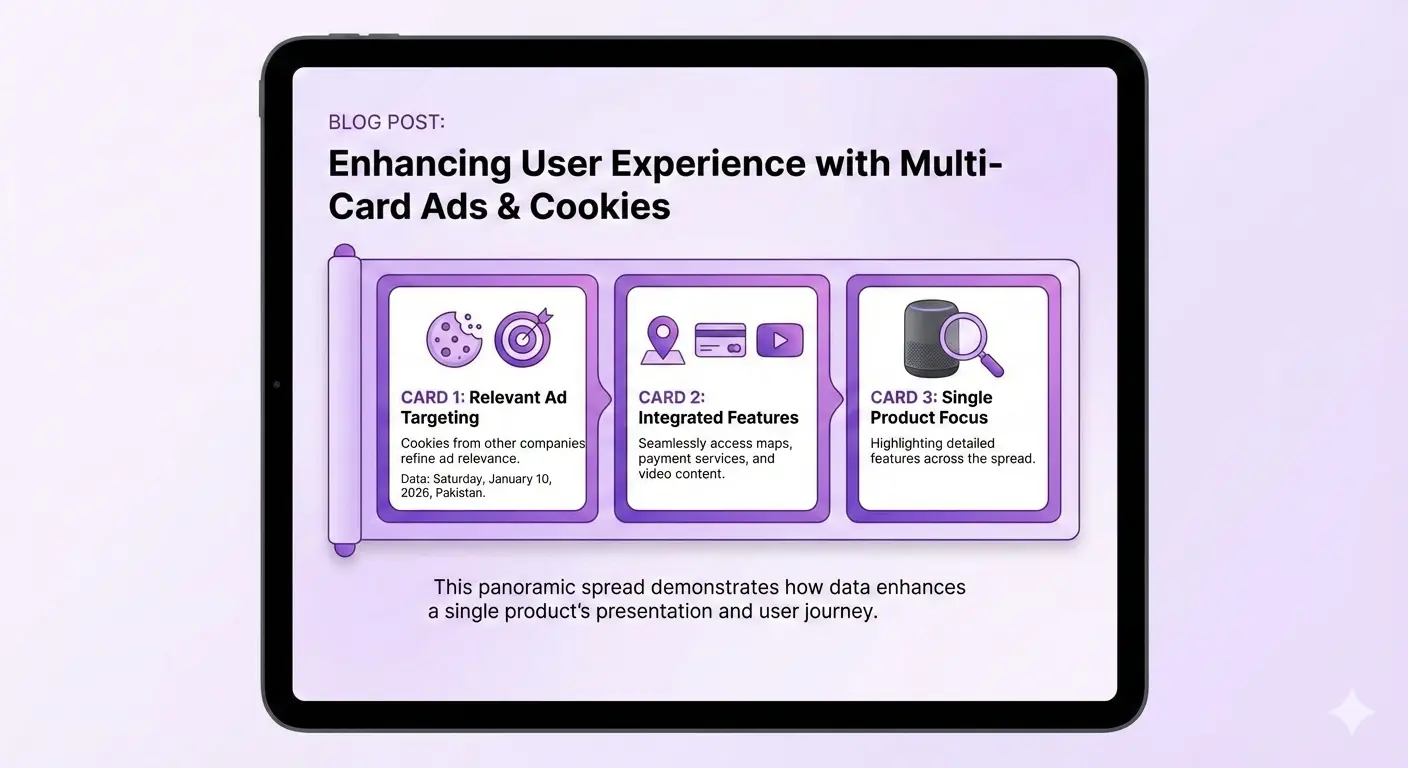
Highlights details of a single product through a multi-card panoramic spread. Cookies from other companies can enhance ad targeting and user experience by delivering more relevant advertisements and integrating features like maps, payment services, and video content.
Clearbit
Uses graphic arrows to visually cue audiences to follow along. Clearbit clearly outlines the benefits of their product while also visually prompting people to swipe and learn more.
BarkBox
Uses humor to creatively maximize the carousel ad format to promote an offer for new customers. This novel approach will naturally prompt users to swipe until the end of the carousel.
Fender
Relies on strong visuals to make the process of customizing a guitar easy to understand. By using clear and colorful visuals and a small amount of copy, this ad makes the process and customization options easy to understand.
Kajabi
Each slide on this carousel has a purpose: to show off key product features. By making effective use of the carousel ad format, Kajabi makes a strong case as to why offering a coaching business is a great solution.
GoDaddy
This ad speaks directly to the consumer, and shows off the product in a creative way to keep audiences engaged. This GoDaddy carousel ad artfully uses text in its images, while using captions and CTAs to further its message.
Shutterfly
This ad walks through a process and creatively tells a story at the same time and highlights a unique product offering. By using their ad creative and copy in a playful way, Shutterfly uses the carousel format to keep audiences interested in just a few slides.
Typeform
This ad speaks directly to businesses and puts them in their customer’s shoes to show off their user experience. By showing each step of their interactive survey template, and sparking inspiration for how businesses can address their customers with a “human touch,” this carousel ad is a strong and cohesive product snapshot for potential users.
Epson
This short carousel ad uses bright visuals and value-based copy to engage audiences. The ad’s strategic use of sequential text and images in the first two slides are just enough for audiences to interact and get the message.
Deezer
The company used a long image of The Beatles to announce that the band’s music was available on the app. The headline space includes the news, while the picture captures attention easily.
Tesco
Tesco used a carousel ad to showcase a step-by-step recipe for a yummy chocolate cake with the link to the full recipe on the last card.
Audible
Carousel ads and Audible were a perfect match. They included a different book cover on each card with a link leading to the store.
Spindrift
Spindrift uses its ads to tell a story instead of selling a product. Each card contains a different aspect of its story and helps boost brand awareness.
Cupshe
This company used all available cards to showcase an entire collection of their trendiest swimsuits, allowing the viewers to get acquainted with their entire offer.
Bethesda
When promoting their game Fallout 4, Bethesda used carousel cards to show reviews from different sources. This was a great way to convince potential buyers of how great the game is.
How to Create One Long Image
Creating one long image that spans across multiple cards can be a visually appealing way to showcase a single product or concept. To do this, determine the number of cards you want to use, create an image with the appropriate dimensions (e.g., if using three cards, the width should be three times the standard card width), and then slice the image into individual cards using image editing software.
The One Big Secret to Success
The one big secret to success with Facebook Carousel Ads is to be intentional. Don’t just create a carousel ad because you can. Instead, develop a clear, cohesive strategy that maximizes each component of the ad. Map out the message you want to illustrate throughout the carousel and tell a story that captivates your audience.
Additional Facebook Ad Strategies
Beyond carousel ads, consider these additional Facebook ad strategies to enhance your overall marketing efforts:
Facebook Campaign & Ad Types
Explore different Facebook campaign types, such as brand awareness, reach, traffic, engagement, lead generation, app promotion, and sales. Each type is designed to achieve specific marketing goals.
Facebook Ads Budgets & Bidding
Understand how to set appropriate budgets and bidding strategies for your Facebook ads. Consider factors such as your target audience, campaign objectives, and industry benchmarks.
Facebook Marketing Strategies
Implement comprehensive Facebook marketing strategies that include audience targeting, ad creative optimization, and A/B testing. Continuously analyze and refine your approach to maximize your Return on Ad Spend (ROAS).
In conclusion, Facebook Carousel Ads are a powerful tool for driving engagement, conversions, and brand awareness. By grasping the Facebook Carousel Ad Sizing and Specs, enacting carousel optimal strategies, and refining your visuals, you can craft captivating advertisements that strike a chord with your intended demographic. The creative Facebook Carousel Ad Examples from leading brands serve as inspiration for developing innovative campaigns. By harnessing these tactics, you can proficiently capitalize on Facebook Carousel Ads to realize your marketing goals and elevate your overarching Facebook advertising strategies.